
Exclusive: Director Max Hunter, actors Matisse Ratron-Neal, Terry Bell talk Off-Broadway play ‘The Pass’
Currently playing Off-Broadway at LaMama for a five-week limited run through September 4 is the American premiere of John Donnelly's The Pass. Directed by Max Hunter, the cast includes Matisse Ratron-Neal as Jason, Terry Bell as Ade, Ino Badanjak as Lyndsey, and Oliver Rowland-Jones as Harry.
The play Initially premiered at London's Royal Court Theatre in 2014, and then adapted into a film released in 2026.
A hotel room in Eastern Europe, 2014. On the eve of their first Champions League match, two rising British football stars find themselves facing something neither preseason training nor media coaching could prepare them for. The Pass explores masculinity, desire, and the brutal machinery of fame. Sometimes the biggest risk isn't losing the match.
Blackfilmandtv.com’s Wilson Morales spoke with director Max Hunter and his lead actors Matisse Ratron-Neal and Terry Bell on the making on the play.
What led you to take on this?
Max Hunter: I was trying to figure out the next sort of play to tackle, and for me, a big piece of determining sort of what is interesting to me is what kind of story are we telling in theatres, and how is a story specifically and intrinsically a theatrical experience. So, for a play like this that is a global story, we follow this professional soccer player, you know, a David Beckham-like star, but for us as a theatre audience, we only ever meet these people in these series of discrete hotel spaces.
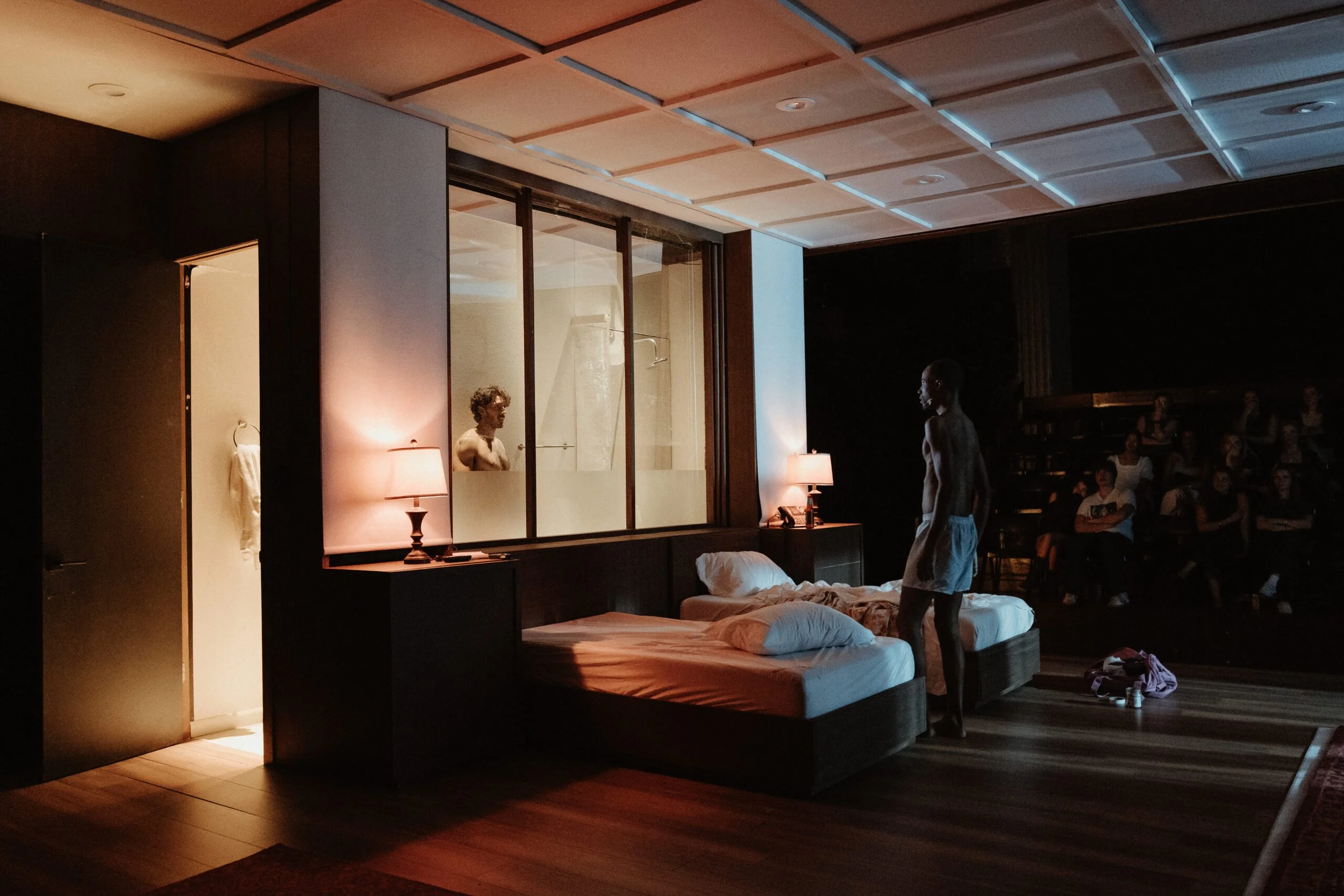
So it's a really lovely juxtaposition of a life lived in the public eye, but we get to be flies on the wall of these spaces where people feel safe and protected and vulnerable to really being themselves and having true conversations and true fights and really, like, mucking through the shit in life that is so often a performance or, you know, the high-gloss, sleek shine in the public eye. It's also just a beautiful exercise in how can the physical and emotional intimacy of an audience to the play space impact how we receive a narrative. So for a play like this that mimics the construction of professional football matches, you know, we are looking through the action into this world and then across into another bank of people, always reminding us this story is being seen and encountered live as a shared cultural event. And I think that just naturally amplifies so much of, like, how this play operates, how this play vibrates, and what this play is really trying to sink its nails into.
What led you to saying yes to taking on this role?
Matisse Ratron-Neal: Well, the first time I had the audition, I read the script before I even looked at anything else. And, I mean truly, not in the spirit of any falsity. It was really well. I think there is something so ugly and rich to be mined within this play.
And, being just sort of an Anglophile in general and having a great passion for British theatre. Seeing something that didn't feel like a lot of the theatre we've become so accustomed to in recent times. Seeing in the city, it's felt adventurous and original. And, obviously the intersection with the World Cup was like a perfectly normal thing. I think it was exciting to see a play that was trusting an audience to be smart enough to figure it out. And, those things were green lights right away.
How much did you know about this before you took on the role?
Terry Bell: Nothing about the play. A little bit about soccer, but nothing about the play.
Was it always meant to be a white guy and a black guy?
Terry Bell: Yeah, I think as written, it is in the script. Ade, the character that I'm playing, is a Nigerian-born British national, and Jason is a white guy, so that's how it comes.
The play originated over a decade ago, then there was a film, but it came out, started in London. Does it translate to an American audience, and is it timeless?
Max Hunter: I think this play does such a lovely job at being hyper-specific without ever being overly expositional. This play treats its audience with intelligence and respect, and even if you know nothing about football or professional sports, this play is about the lives and relationships and ambitions of our individual characters. This is not a play where we, you know, watch sporting events or follow actual, you know, games in any effect. But I think it's more, it's the backdrop to a very specific, very decadent, very sexualized, very ambitious group of people under the scope of something that I think everyone understands, especially with the World Cup, especially with the U.S. Open later this year.
We are never too far from a massive global sports event. And I think what is so exciting about this play is, again, it lets us into that world without ever treating us like we're idiots, you know, treating us like we don't know anything about how the world works. I think theater needs to be a big tent medium, and I think all stories are worthy of exploration, just with the specific angles of how you curate and what's the narrative of the story and how you design for that space.
There's the original that came out over a decade ago. There's the movie. Had you paid attention to that, any one of them, to get an idea as to how to play your character?
Matisse Ratron-Neal: I intentionally stayed away. I am not always the most capable of separating myself from those things, even after experiencing them. And, so I thought to myself, it's better for me to just only read this, not consume any media related to the show. I didn't want to have an idea of what I was supposed to be doing. And, also I think Max and I had lengthy discussions before we started rehearsal, after we agreed to do this. We had a real interest in doing something maybe different than our understanding of what it had been. And, he was familiar with the movie. He hadn't seen it either. But, we talked about just what we knew about the ending. And, we were like, that's not the play that we're doing. It's the same script, but that's not the play that we're trying to have. It's not the play we want people to come and see. And, so from that forward, I thought, I'm going to stay away from those things. And, when it comes to sort of developing a character and creating the psyche of a person who, as we watch them over the course of these 12 years in this play, really starts to disappear in a lot of ways, it's important to be able to try as many different things as you can. And, I think in preparation, you find one alleyway, and you start doing other things, and you slowly discover them.
When you take on this role, what did you want to do different outside of the script call for?
Terry Bell: Great question. I mean, the first thing that I'm always really interested in in a play is the soundscape. I think that you can tell a lot about where a person is from and who they are based on their dialect and how they talk. So that was something that coming in was my big focus. There's actually a relatively newer accent called MLE, Multicultural London English, I think it is. It's about a 30-year-old accent, but it's very similar to, in America, we'd be familiar with AAVE, and how black people from all over the country have a certain patois, a certain dialect that is similar across regions. And so that has been my big focus. It's not an accent that you see a lot in America, really, and it's, I think, really authentic to people where Ade is from. And so that's something I've been diving really deep into during this process.
When you take on a role like this, what do you do to get into character? Do you do research, do you talk to people who may have gone through something similar?
Terry Bell: It's what we call in the theater dramaturgy, which is basically just research about whether it be any reference, any slang mentioned in the show, any town mentioned in the show, things like this. And I find it the easiest to access a play through a heavy dramaturgical lens. So I'm going to be doing a lot of looking for people that are from the same area or speak the same dialect. For example, there's a Nigerian-British-born rapper named TKANDZ. That is somebody that I've been listening to a lot that would have a very similar dialect. Obviously, getting into the sport, these two people are professional athletes, so I'm going to be looking at interviews with football soccer players, particularly British-born but black, whether they be from Nigeria or someplace else in Africa. But yeah, it's a lot of research. I think that's the biggest thing that people... It's one of the biggest misconceptions about acting is that actually it's like 60% looking up a thing and trying to figure it out that way.
Matisse Ratron-Neal: Well, I definitely, the sort of surface level research of, like, British football. And, the culture that these people find themselves in. The references these characters are making. Says a lot about who they idolize and who they don't idolize. So, that was a big part of it. Past that, it's, you know, I think that the greatest preparation that's happening is just getting into figuring out where you intersect with the character. Where you don't. And, the parts that you don't, you have to shore those up. Say, okay, well this is something I would never do. How can I find a way to access that? How can I find a way to make that feel like something instinctual? Because, when you're on stage, you're hoping that those things are going to be instinctualized in that character. And, Max has been so excellent about reinforcing being able to be, to sort of throw all the paint at the wall.
Max, with this play did you do want to bring something similar but also make it your own?
Max Hunter: I'm sure there are people who saw it in London, who may have seen the film, and, you know, obviously they can get an idea. Are you doing anything totally different, contemporary or whatever? Yeah, I think the beautiful thing about this play is it was written and produced in 2014, but there's nothing about the play that dates it as a period piece. I think what is both exciting and challenging or, you know, speaks to the state of the world is that it is still a struggle for people who work and live in certain circles to have the freedom to sort of say, am I comfortable being an honest version of myself? Can I explore and really chase the things that are truly exciting to me? Or do I have to hide or cover or present in a certain way? I don't think that has massively changed in the decade or so since it's produced in London.
I think, if anything, we're seeing, I think the general public is even more aware of, like, the metatextual mechanisms of industry and fashion and business and how all of these commercialized components of the job outside of how good does someone perform on the pitch, that complicates, in a very messy and real way, I think, a lot of the challenges of these characters. So, to me, it is equally vital now as it was then. I think for us to get to present it, we haven't changed a word, but it still vibrates today in a very authentic frequency.
And I think what is so exciting, again, the original production in London was built with a specific team and a specific building and a specific set. The movie was adapted by a different team for, you know, each of these productions has to live authentically in its own box. And for us, with this team, to get to come to La MaMa and build a theatrical environment and set in the way we have, what excites me is about creating something specific to this team, to this moment, to this building on East 4th Street and make it come alive as authentically as we can for these audiences today without trying to chase or speak to a supposition that maybe someone has seen or has some expectation from a theatrical perspective of what this show should be.
How's the chemistry with the cast been so far?
Terry Bell: Oh, it's been excellent. It's a great group, really great squad. We're all getting along really well, we're having a lot of fun in the room and that's all you can ask for.
Matisse Ratron-Neal: Incredible. Listen, let me tell you. I think it was really clear from the first day. I always try to lead with a sense of humor, because I think that's kind of the easiest way to have everybody feel at ease, myself included. And, when that was matched by a lot of these other people that you know, and I instantly, especially having a scene that's got such, such back and forth, and then with Oliver being able to relate on being, love of British culture, and we talk about British snacks and all these things, and Terry is just like such a consummate professional, and sitting with him and watching him work, it's easy to see how the four of us were chosen without ever having the four of us in the same room, because Max was able to see, I think these people are all going to mesh really well. It's going splendidly.