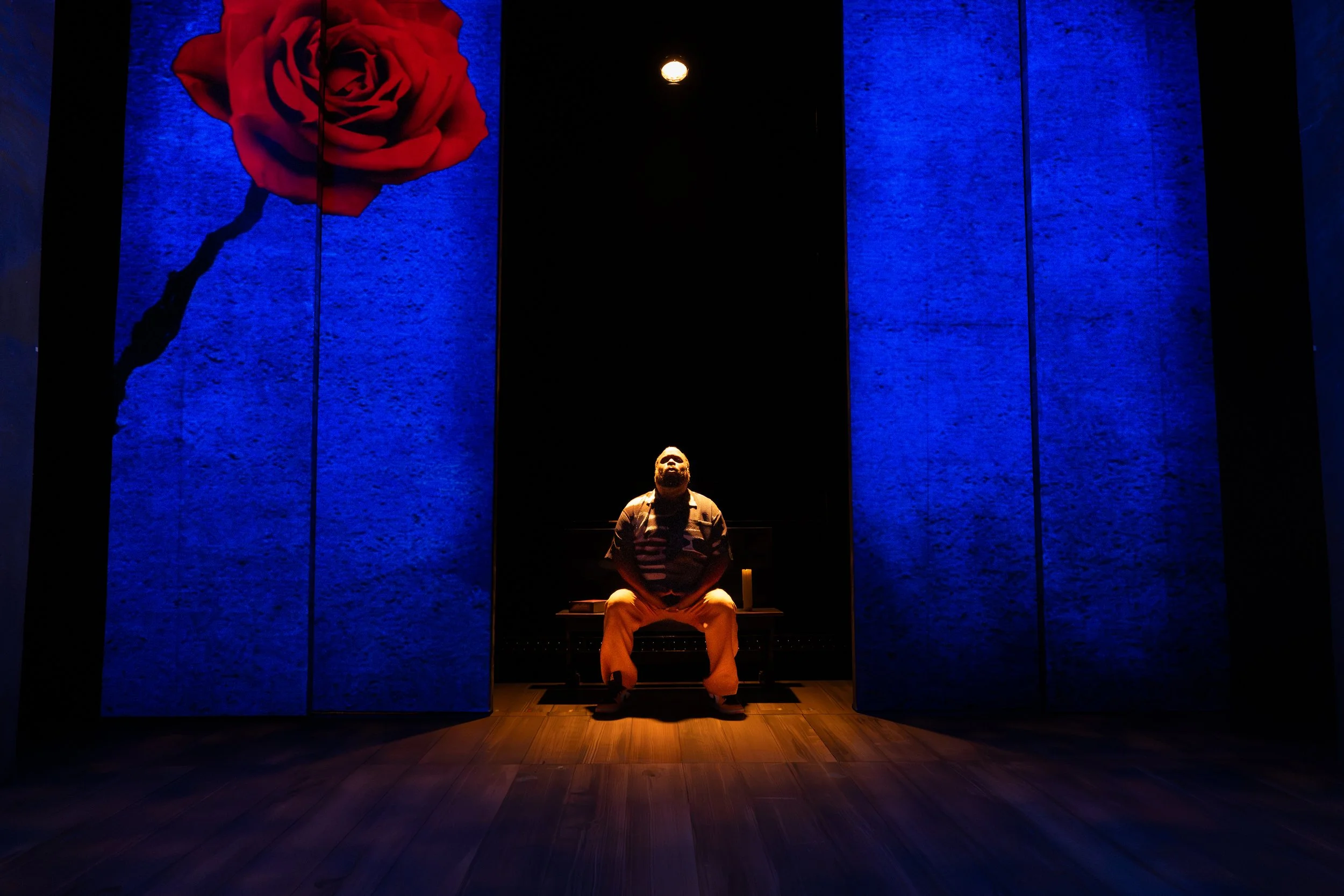
Exclusive: Jacob Ming-Trent talks Red Bull Theater's How Shakespeare Saved My Life
Now playing at The Public Theater (in conjunction with Red Bull Theater) is the New York premiere of HOW SHAKESPEARE SAVED MY LIFE, Jacob Ming-Trent’s one-man show, directed by Tony Taccone, about the creatives that molded him.
Previews began in the Shiva Theater on Tuesday, September 15 with a Joseph Papp Free Performance. Ahead of first preview, the production has also been extended by one week and will now run through Sunday, October 25, with an official press opening on Sunday, September 27.
In the Red Bull Theater production of HOW SHAKESPEARE SAVED MY LIFE, Jacob Ming-Trent dares to rescue himself from the “slings and arrows” of his past. Born with a gift for poetry but rejected as unfit to play the part of the poet, Ming-Trent invites us to take a deep dive into the crevices of his youth. His search for home is relentless, and the results are by turns hilarious and tragic. Calling on the Bard and a host of genius rappers, half-crazed preachers, and soulful poets to throw him a lifeline, he takes us on a propulsive ride that reaffirms the power of language. It all adds up to one man’s attempt to reclaim his life, and through that journey we connect to the deeper parts of ourselves, and, ultimately, to each other.
Blackfilmandtv.com caught up with Ming-Trent as he spoke the making of the play.
What an interesting title. So, how did this come about for you?
Jacob Ming-Trent: Well, I was writing a cabaret for a theater company, and when I went to sit down to write it, a lot of stories from my childhood started coming out, and the theater company that I was writing for didn't want that. Didn't want that for the capital, right? So, but I kept writing, and stories just kept flying out from my childhood that I had forgotten or tried to repress. It was like my spirit, like my subconscious is like, no, you got to get this out, you got to talk about this. So that's how it started, and I just kept rolling with it.
Is this a one man show?
Jacob Ming-Trent: One man, and I never wanted to do a one man show. I didn't want to be up on stage all alone, so I didn't. It's not for vanity. It's it's seriously not for vanity. It's just because I needed to tell the story, not just for me, but for somebody else.
It's already challenging enough to be be on stage and be in a lead. But when you're doing it and you're doing it by yourself, it's almost like being a comedian. You got to carry that audience throughout the whole time.
Jacob Ming-Trent: Yeah, it's challenging, very challenging, and you know I've been acting for 30 years, and it's one of the more challenging things I've done. It's also just as rewarding because you know it's it's difficult to do. You're tired, exhausted, you know. But what gets me out of bed? It's like, yo, I think somebody needs to hear this story today. That gets me out of bed, man, to feel like I'm doing something for somebody else, you know. So it pushes the limits of my talent, and it's opened up some parts of my talent that I didn't even know I had, you know. So it's been a an awesome journey. It's been a great journey.
Are we getting quotes from Shakespeare plays, or we're just hearing you trying to do Shakespeare, or how certain plays affected your life.
Jacob Ming-Trent: Well, it's about we start, you know, the show starts when I'm 12 years old, and it starts when I first discovered Shakespeare, and so you get to see that, and then you get to see how I used Shakespeare as a 12-year-old, and as a 14-year-old, and as a 16-year-old, how I used to argue with my mother, or how I used it to argue with the teacher, and how I used it to woo a young lady, and you see all that, and then you also see how Shakespeare, at times, wasn't there for me. Shakespeare opened a lot of doors, but some doors it didn't open, and so you see my struggles with that.
Is this more of a dramedy?
Jacob Ming-Trent: You laugh, you cry, you get upset, you get pissed off, you'll be astonished, all all of it. You'll feel all of it. I'm proud of that. I'm like, it's a wild ride, man. It's a for one last show. It's a very wild ride.
What are some of your favorite Shakespeare plays?
Jacob Ming-Trent: 12th Night, I love, I love. Actually, I do love Henry the Fifth, The Tempest, I love. You know, I can find something to enjoy in all of them. I mean, Mary Wives of Windsor, Midsummer Night's Dream. I mean, in this story, you're gonna hear a lot of Shakespeare, because Jacob, as he goes through life, he knows the right Shakespeare for the right moment. And sometimes it works, and sometimes it doesn't work. He has to deal with that. He has to deal with it not working. He goes to see Othello, and you see his reaction to it because he's never seen it before. You know, so you know, it's I love Shakespeare, but I also know there are limitations to Shakespeare. I love Shakespeare. I love Kenneth Branagh, Ian McKellen, and and all those guys, and I grew up trying to emulate them and trying to be them because they were the best. But I realized that in trying to be them, I couldn't be myself. And so my best acting was when I was pulling from my life, when I was pulling from the characters in my family. So you also see Jacob discover that as well.
How long is the show?
Jacob Ming-Trent: Hour and a half.
How do you find time between doing what you want to do next, or what goes into saying yes?
Jacob Ming-Trent: Good question. Nowadays, it's more complicated. When I was younger acting, I was just trying to work, just trying to afford a rent and food and all that stuff. Now, I pick things that it will have that will affect the community. This show has had a great effect on the communities that it's been performed in, and that's my goal. That's what I want to do for the rest of my life. I want to be a storyteller, and I want to change people's lives, even if it's just by 0.1% I want to change people's lives by 0.1% and sometimes I'm able to do it. So that's what I think about. So if you called me up and you said, "I want you to do Richard the Third, I was like, "Where are we doing it, and how can we do it to affect those people that are going to come see it.
How do you prefer Shakespeare to be done? Do you want to do it how we know it, or do you want to do something different?
Jacob Ming-Trent: I prefer to be impactful. So you got to think about, like I said, you got to think about where you are and who you're talking to. When we did "Mary Wives in the Park" and Jocelyn Bioh adapted the script, she she wanted it to be about Black Joy, and we were able to do that, and that was very successful. I also did a Cymbeline that was pared down, only seven people. That had a whole nother vibe, so I don't care if if you're a purist, that's great. If you're somebody that likes to play with the text, like me, that's great. As long as the people that are coming are being served, and they're being served the story that they can take home with them.
What's the elevator pitch to the show?
Jacob Ming-Trent: The elevator pitch to the show: a troubled young man meets the greatest writer in the world, and he uses that writer to try to survive and get through life.